Idle Racer — Tap, Merge & Race
CASUAL AZUR GAMESRacing
4.31.00K Reviews
- Version
- 0.9.275
- Installs
- 10.00M
- Age Rating
- Everyone
Screenshots
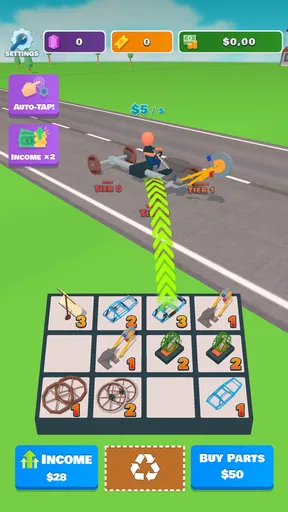
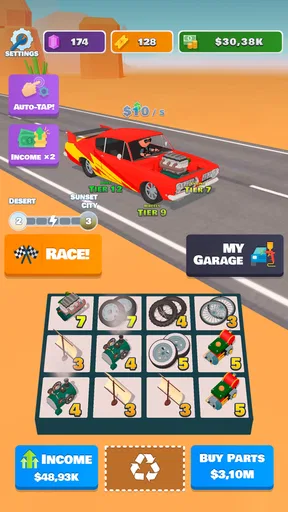
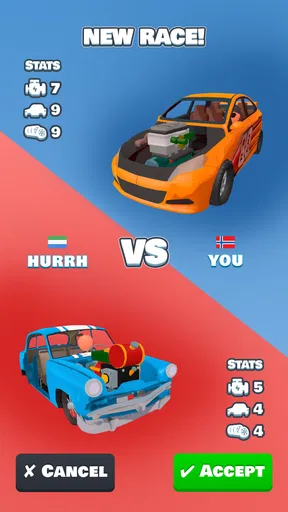
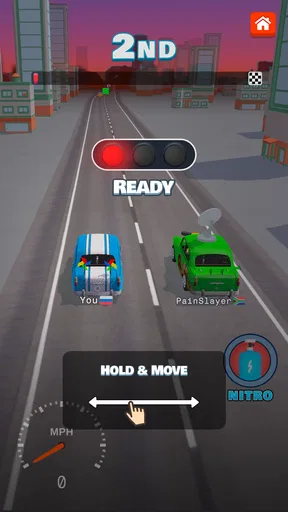
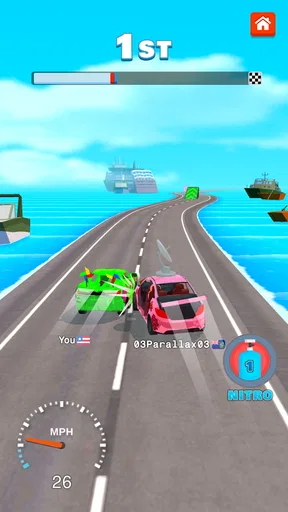
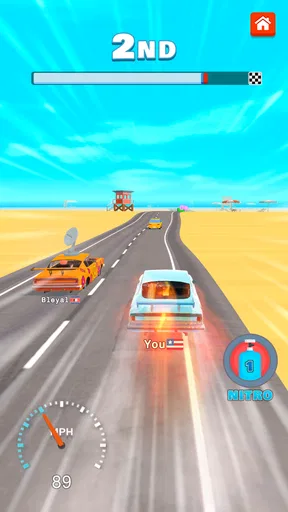
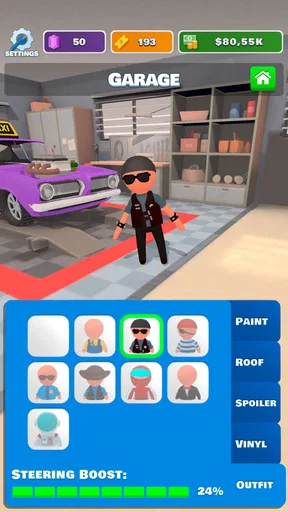
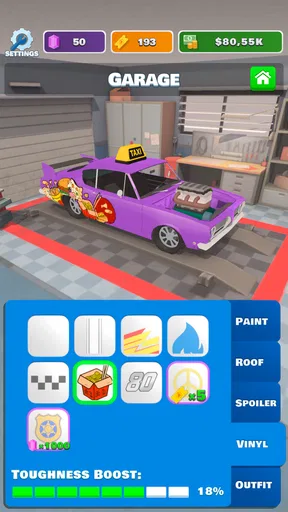
Our Review of Idle Racer — Tap, Merge & Race
 Analysis by Appyee
I spent time with Idle Racer as a quick, upgrade-focused racing game rather than a traditional driving simulator. That distinction matters from the first few minutes: the appeal is not precise cornering or long championship events, but building a car, improving it, and watching each decision push the next run forward. It is a comfortable fit for short sessions when I want something active enough to hold my attention without demanding a full block of uninterrupted time.
Created by CASUAL AZUR GAMES, this free racing game has grown to more than ten million installs and an average rating of 4.3 from roughly thirty-two thousand ratings. Those figures suggest a broad audience, and my experience explains why: the basic loop is easy to understand, the presentation is approachable, and progress arrives in small, satisfying steps. At the same time, players looking for a serious wheel-to-wheel racer should understand that its priorities are very different.
How the everyday racing loop works
The most useful way to approach the game is to treat each session as a small maintenance routine. I begin by checking what the current car can improve, then I use the available progress to make the next attempt more productive. The construction and upgrade focus gives the game its identity, while the racing element supplies the reason to keep refining the vehicle.
That workflow makes it especially suitable for a commute, a short break, or the few minutes before bed. I can open it, make a meaningful adjustment, watch the result, and leave without feeling that I abandoned a complicated event halfway through. It also works well for players who enjoy seeing a project gradually become stronger. The car is not just a vehicle selected from a menu; it is the object I keep shaping through repeated decisions.
The word “idle” should be interpreted carefully. I still need to pay attention to progression and upgrades, but the experience is lighter than a conventional racing game. The satisfaction comes from managing momentum rather than mastering a demanding control scheme. If you enjoy tapping through improvements and observing the effect on performance, the structure is immediately welcoming.
My first practical recommendation is to avoid spending every resource the moment it appears. I found it more useful to pause briefly and look at the whole upgrade situation before committing. A small improvement that helps the next few races can be more valuable than an attractive change that leaves the rest of the car lagging behind. This habit is simple, but it prevents the early game from becoming a series of impulsive taps.
The game is also friendly to uneven attention. If I have only a minute, I can focus on one upgrade or one short racing cycle. If I have longer, I can stay with the improvement loop and make several decisions in sequence. That flexibility is one of its strongest everyday qualities. It does not ask me to remember a complex control layout after a long break.
What to check before spending resources
Before upgrading, I recommend looking at the immediate obstacle rather than automatically choosing the most visible button. The best choice depends on what is currently slowing progress. When a race feels close but not quite successful, a targeted improvement may be more useful than spreading resources across every available option.
I also learned to judge upgrades by their timing. A purchase that helps right away is valuable when I am actively playing, while a broader improvement may make more sense when I plan to return later. This is not a complicated strategy system, but the distinction gives the idle format more depth than simply tapping whatever flashes first.
Another helpful routine is to make one change, observe the following result, and only then decide whether to continue in the same direction. Changing several things at once makes it harder to understand what actually helped. By keeping the process controlled, I can identify which kind of investment produces the most noticeable progress for my current stage.
That approach also makes the game less wasteful for casual players. Someone who checks in only a few times a day may not have enough attention to correct a chain of poor decisions. A quick review of the car’s current condition before each spending session keeps the limited playtime focused.
Settings and small habits worth checking
I would not begin by assuming that every available option needs changing. The useful habit is to inspect the settings area once, confirm that the game behaves comfortably on the phone, and then leave the interface alone unless something becomes distracting. In a game built around quick interactions, unnecessary menu adjustments can take more time than they save.
For short sessions, I prefer a simple rhythm: open the game, check progress, review the car, make the most relevant upgrade, and return to racing. Keeping that order prevents me from jumping between screens without a purpose. It also makes it easier to stop at a natural point instead of continuing merely because I have not decided what to do next.
Players should also remember that this is a free game with in-app purchases priced at $2.99 per item. I treated those purchases as optional rather than part of the basic routine. The better test is whether the normal upgrade loop remains enjoyable without buying anything. If the main pleasure for you is making careful progress from what the game gives you, that approach keeps the experience clearer and avoids turning every slowdown into a shopping decision.
The age rating is Everyone, which matches the accessible tone and uncomplicated presentation. I would still set expectations properly for younger players: the game is easy to understand, but any purchase option deserves the usual device-level supervision. For adults, the important point is that the title is designed as a light, broadly accessible racer rather than a realistic motorsport product.
Faster patterns for repeat players
Once the basic routine feels familiar, the fastest improvement comes from reducing wasted decisions. I try not to open the game without a small objective. That objective might be improving the current car, reaching the next useful threshold, or simply checking whether the latest change made racing smoother. A clear purpose makes short sessions feel productive.
I also recommend grouping actions. Instead of making one tap, leaving, and returning repeatedly, I handle the available progress in one focused visit. I inspect the car, compare the possible improvements, choose the most relevant one, and then give the result enough time to show itself. This pattern is especially useful for people playing between other tasks.
Another efficient habit is to avoid chasing perfection in every run. The game is more enjoyable when I accept that some attempts are stepping stones. If a race exposes a weakness, that information is useful even when the result is not ideal. I can then direct the next upgrade toward the problem instead of treating the unsuccessful attempt as wasted time.
For players who enjoy optimization, the interesting challenge is balancing immediate gains against a stronger long-term car. An upgrade that makes the next moment feel better is tempting, but the best overall route may involve saving for a more meaningful improvement. I would not follow a rigid formula here; the right choice changes with the current state of the vehicle and how actively I plan to play.
This is also where the title separates itself from ordinary arcade racing games. In a conventional racer, faster progress usually comes from learning tracks, braking points, and controls. Here, faster progress comes from making better upgrade decisions and maintaining a repeatable routine. Players who enjoy tuning a project may find that more rewarding than chasing a perfect lap.
Where the lightweight design reaches its limits
The same simplicity that makes the game convenient can make it feel shallow to experienced racing fans. I did not get the same sense of physical control, track mastery, or competitive tension that I would expect from a dedicated driving game. If your ideal session involves steering through difficult corners, comparing lap times, or learning detailed vehicle behavior, this is probably not the right choice.
There is also a limit to how much variety an upgrade-centered loop can provide. The early decisions feel meaningful because each improvement is easy to notice. Over time, the repeated pattern becomes more predictable. That is not a flaw for someone seeking a relaxing idle game, but it can reduce the appeal for players who need constant new mechanics.
The title’s free structure deserves a realistic evaluation as well. Optional purchases can be convenient, but I would not recommend buying automatically whenever progress slows. First, try changing the upgrade habit: inspect the current weakness, save when necessary, and make each session purposeful. If that still does not suit your preferred pace, the issue may be the game’s design rather than a lack of spending.
Device compatibility is reasonably broad, with support beginning at Android 6.0. That makes it accessible to many older Android phones, although the exact feel will naturally depend on the device. I found the game best suited to players who value quick access and a clean, uncomplicated loop over demanding visual or technical performance.
The current version is 0.9.275, so I would keep the app updated through the normal store process when an update is offered. More importantly, I would not choose it expecting the complete feature set or presentation of a premium console-style racer. Its value comes from being easy to pick up, not from trying to replace a full racing simulation.
Who should play it, and who should skip it
I would recommend it to someone who likes mobile games that turn small decisions into visible progress. It is a good match for players who enjoy building, upgrading, and checking back later. It also suits people who want racing flavor without committing to a long event or learning a demanding control system.
A realistic everyday scenario would be a short lunch break. I can open the game, review what the car needs, make one considered upgrade, and run through the next opportunity before returning to work. The session has a beginning and an end, and I do not need to remember a complicated strategy. That compactness is more valuable than it sounds when a phone game is competing with a busy day.
I would steer competitive racing fans elsewhere if their priority is direct control and measurable driving skill. A traditional arcade racer will offer more excitement through steering and track knowledge, while a simulation will provide deeper vehicle behavior and realism. This game is better for the player who wants to manage a racing project than for the player who wants to drive every meter personally.
I would also skip it if repetitive progression immediately bothers you. The core pleasure comes from repeating a familiar cycle with gradually better results. If you need a story, multiplayer competition, or dramatic changes from one session to the next, the lightweight structure may feel too restrained.
My verdict after building a routine
Idle Racer — Tap, Merge & Race is an approachable free racing game with a clear identity. I enjoyed it most when I stopped comparing it with full driving games and treated it as a compact car-building routine. The best results came from checking the vehicle before spending, making one purposeful improvement at a time, and using short sessions instead of tapping without a plan.
Its strengths are convenience, accessibility, and the simple satisfaction of watching a car improve. Its weaknesses are equally clear: limited depth for serious racers, a repeating progression pattern, and the temptation to view optional purchases as a shortcut. Those trade-offs do not ruin the experience, but they should shape your expectations before installing it.
With a 4.3 average and over ten million installs, the game has clearly found an audience, and I can see why. It is easy to start, free to try, suitable for Everyone, and developed by CASUAL AZUR GAMES for players who want racing progress in small pieces. I would recommend it to casual builders and idle-game fans who like cars; I would not recommend it as a substitute for a hands-on racing simulator.
My final advice is to give the normal loop a fair chance before considering any $2.99 purchase. Build a repeatable habit, save when an upgrade does not immediately solve the current problem, and judge the game by whether those small improvements remain satisfying. For the right player, the real appeal is turning a few deliberate taps into a steadily stronger racing machine, and that focused idea carries the experience well.
Verdict
Strengths of Idle Racer — Tap, Merge & Race
- Simple tap-and-merge controls are easy to learn.
- Short races fit well into quick gaming sessions.
- Car upgrades provide a clear sense of progression.
- Offline play makes it convenient for gaming on the go.
- The colorful visuals and compact interface are easy to follow.
Limitations of Idle Racer — Tap, Merge & Race
- Progress can slow noticeably without frequent upgrades.
- Repeated races may feel monotonous after extended play.
- Higher-tier cars may require considerable grinding.
- Ads can interrupt the flow unless removed or skipped.
- Limited strategic depth may disappoint experienced racing fans.
Other Releases by CASUAL AZUR GAMES
View All
Worms Zone .io - Hungry Snake
Action4.3

Stack Ball - Crash Platforms
Arcade4.5

STAR: Super Tricky Amazing Run
Arcade4.2

State.io — Conquer the World
Strategy4.1
Similar Picks in This Category
View All
Hill Climb Racing
Fingersoft4.3

Dr. Driving
SUD Inc.4.2

Traffic Rider
skgames4.5

Asphalt 8 - Car Racing Game
Gameloft SE4.6

Race Master 3D: Car Racing
Beresnev Games4.6

Extreme Car Driving Simulator
AxesInMotion Racing4.3
Frequently Asked Questions
What is Idle Racer — Tap, Merge & Race?
Idle Racer — Tap, Merge & Race is a casual racing game that combines idle progression, tapping, vehicle merging, and short racing challenges. You collect or upgrade cars, combine matching vehicles to create stronger models, and earn rewards as your garage and racing performance improve. It is designed for quick sessions, making it suitable for players who enjoy gradual progress without complicated controls.
How do you play Idle Racer — Tap, Merge & Race?
The main gameplay loop is easy to understand: tap to generate progress or resources, merge compatible cars to improve your collection, and enter races to earn additional rewards. As you advance, you can usually unlock better vehicles and increase your earning potential through upgrades. Although the controls are simple, choosing when to merge, upgrade, or spend resources can make progression more efficient.
Does Idle Racer — Tap, Merge & Race require an internet connection?
The game may allow some idle or basic progression while offline, but an internet connection is generally recommended for the complete experience. Online access can be needed to load advertisements, synchronize progress, receive events, or access certain rewards and features. Before downloading, players should also remember that offline behavior can vary between versions and devices, so it is best not to rely on the game as a fully offline title.
Is Idle Racer — Tap, Merge & Race free to download and play?
Idle Racer — Tap, Merge & Race is generally available as a free download, allowing players to begin racing and upgrading without an upfront purchase. However, free-to-play games commonly include optional advertisements and in-app purchases for extra currency, boosts, or faster progress. You can usually play without spending money, but patience may be necessary if you choose not to use paid advantages or watch optional ads.
Is Idle Racer — Tap, Merge & Race suitable for children and casual players?
The game is accessible to casual players because its controls are straightforward and its races are presented in short, manageable sessions. It can also appeal to younger audiences who enjoy cars, collecting, and simple progression. Parents should still check the store rating, privacy information, advertising content, and purchase settings for their region, since the exact age guidance and monetization options may differ between Android and iOS versions.
Play our best games!


